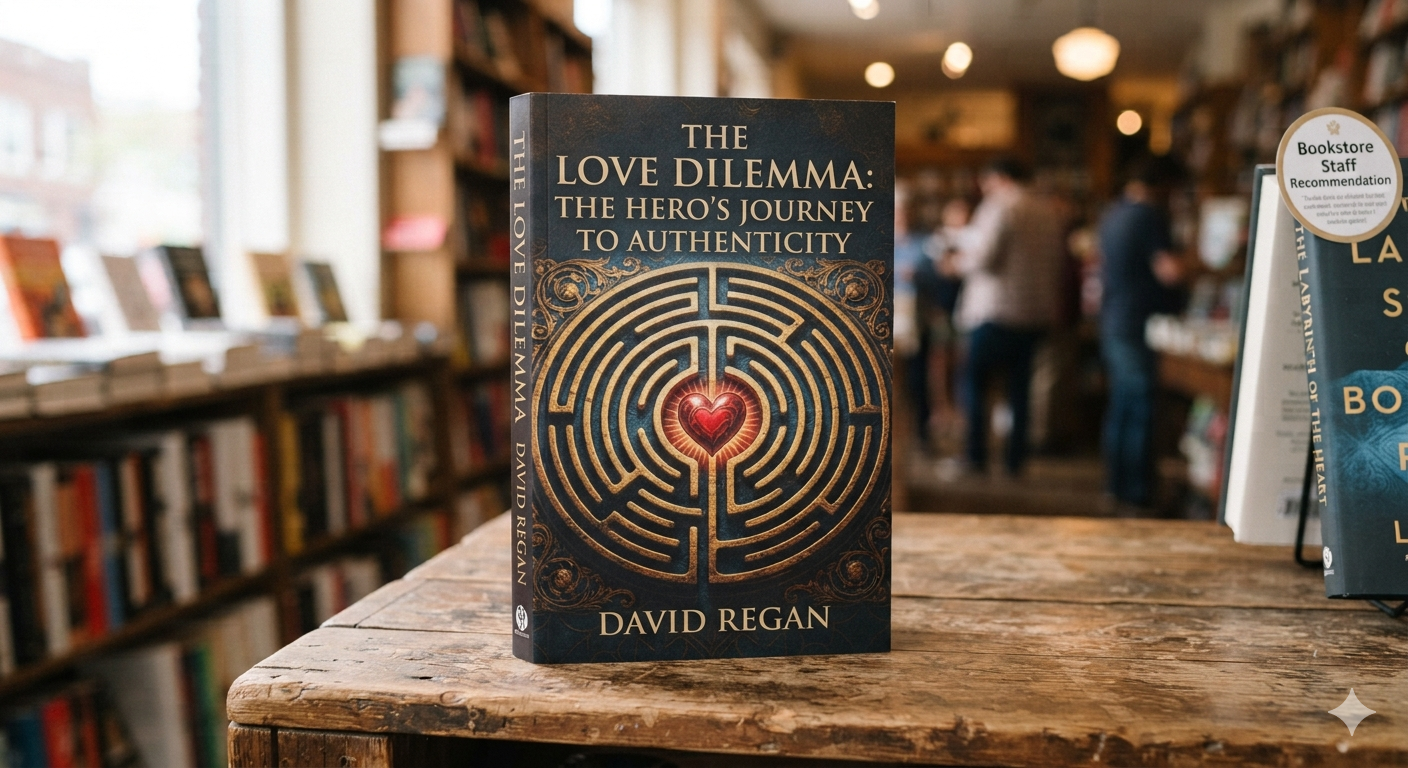
The Love Dilemma
The Hero’s Journey to Authenticity
A forthcoming book
Most people believe they are living for happiness. They are not.
Beneath the striving, the relationships, and the lives we carefully construct lies a quieter and more powerful driver: the need to prove we are worthy of love. This is the wound at the center of what David Regan calls the Love Dilemma.
It begins early. In infancy, we form a deep association between love and survival. As we grow, shaped by expectation and social conditioning, a fear emerges that is difficult to escape: what if I am not enough as I am? To resolve that tension, we construct an ego, not arrogance, but an intelligent strategy designed to secure love, approval, and belonging. What begins as protection gradually becomes identity. And in trying to become who we believe we need to be, we gradually lose connection with who we actually are.
That disconnection changes everything. Although we believe we are pursuing happiness, much of our behavior becomes organized around seeking reassurance that we are enough. Success, approval, relationships, achievement: all become ways of answering the same underlying question. Yet reassurance never resolves the underlying fear. Its effects are temporary, and the search never ends. Even when we get what we thought we wanted, the joy and fulfillment we expected often fail to fully land.
Part One traces this dynamic from its developmental origins through relationships, history, mythology, and contemporary culture, showing how a wound formed in childhood scales outward to shape the world we share. Part Two turns Joseph Campbell's Hero's Journey inward. Drawing on myths, parables, and wisdom traditions from Arthurian legend and the Bhagavad Gita to Zen and Daoist teachings, it offers a practical path through the labyrinth of the constructed self and back to the heart. Through departure, initiation, and return, readers learn to recognize their own ego patterns, reconnect with their inherent worth, and cultivate what the book calls spiritual fitness: the ongoing practice of finding their way back to themselves when life pulls them off course.
The destination is not permanent happiness or freedom from ego. Fear will return. Old patterns will return. The aim is to develop a different relationship with them, and to know how to follow the thread home.
This is not a book about becoming more. It is a book about remembering who you were before you learned to be someone else.
This book is currently seeking publication
In the meantime, many of the ideas that shaped the book are explored in my essays on Substack and inform every coaching conversation I have.